Watch This If Your Coding Agent is Ignoring Your Rules (You Need Hooks)
Demonstrates building coding agent hooks via the hooks-create skill to enforce workflow guarantees through events, scripts, and wiring for tests and security.
Videos
Find videos about LLM models, hardware, runtimes, benchmarks and practical AI workflows.
Demonstrates building coding agent hooks via the hooks-create skill to enforce workflow guarantees through events, scripts, and wiring for tests and security.
Locally tests GLM-5.3-Flash, identified as the first natively multimodal model in the GLM-5 series.
Tests Qwen3.8 Flash Next on browser workflows, C++ games, Blender, Godot, local Q4, FPS generation, and 3D scenes.
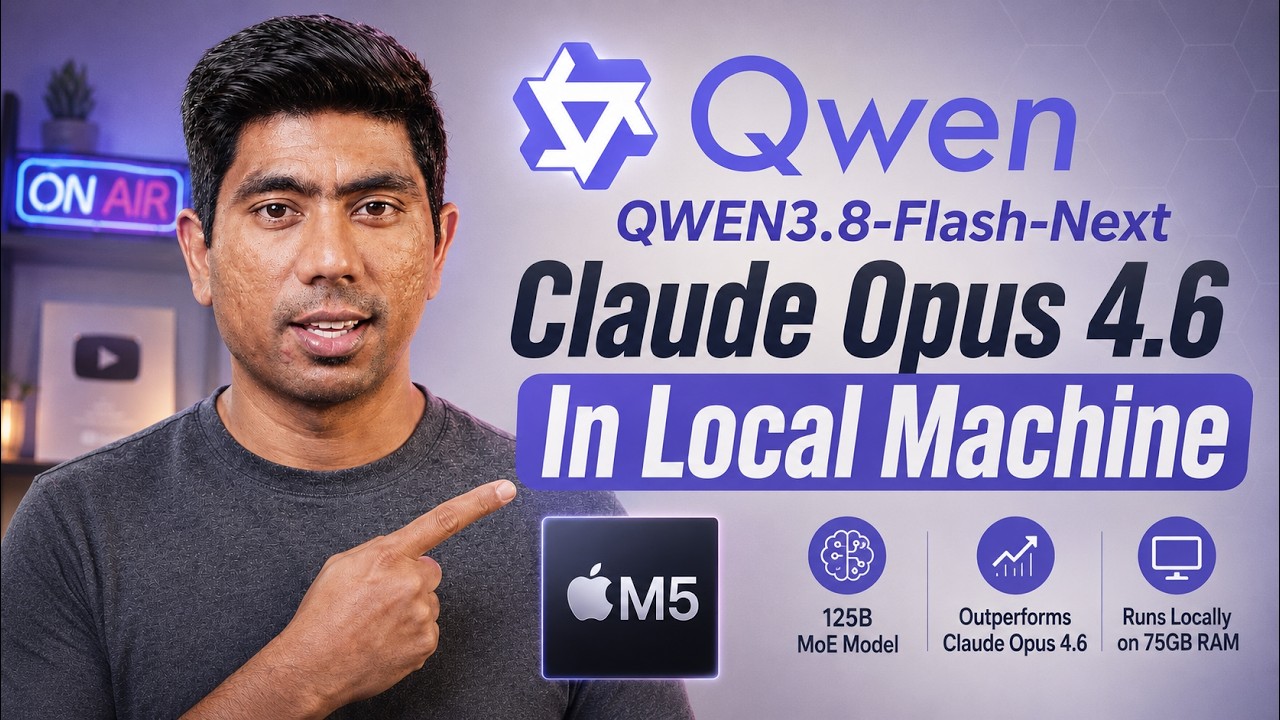
Locally installs and tests Qwen3.8-Flash-Next.
Explores Qwen3.8-Flash-Next architecture and runs local inference via Unsloth GGUF and llama.cpp on Apple Silicon, covering 1-bit and 4-bit quantization setups.
Compares Qwen 3.8 Flash Next and Qwen 3.8 27B architectures, detailing MoE, sparse attention, gated residuals, 51B n-gram lookup tables, and RTX 5090 MTP measurements.
Tests combining multiple GPUs into a single desktop setup with 224GB of memory to evaluate performance beyond intended specifications using Strix Halo, LLM and Nvidia components.
Integrates Model Context Protocol into the TalkWithMe Star Trek group chat using mcp-light to enable AI personas to perform actions within an agentic loop rather than passive chatting.
Explores running a 26B parameter MoE model on limited memory, comparing weight sizes across FP16/BF16, 8-bit, 4-bit, 3-bit, and 2-bit quantization levels.
Demonstrates running Qwen 3.8 27B on consumer-grade computers using LM Studio to select compatible high-quality quantizations and manage downloads.
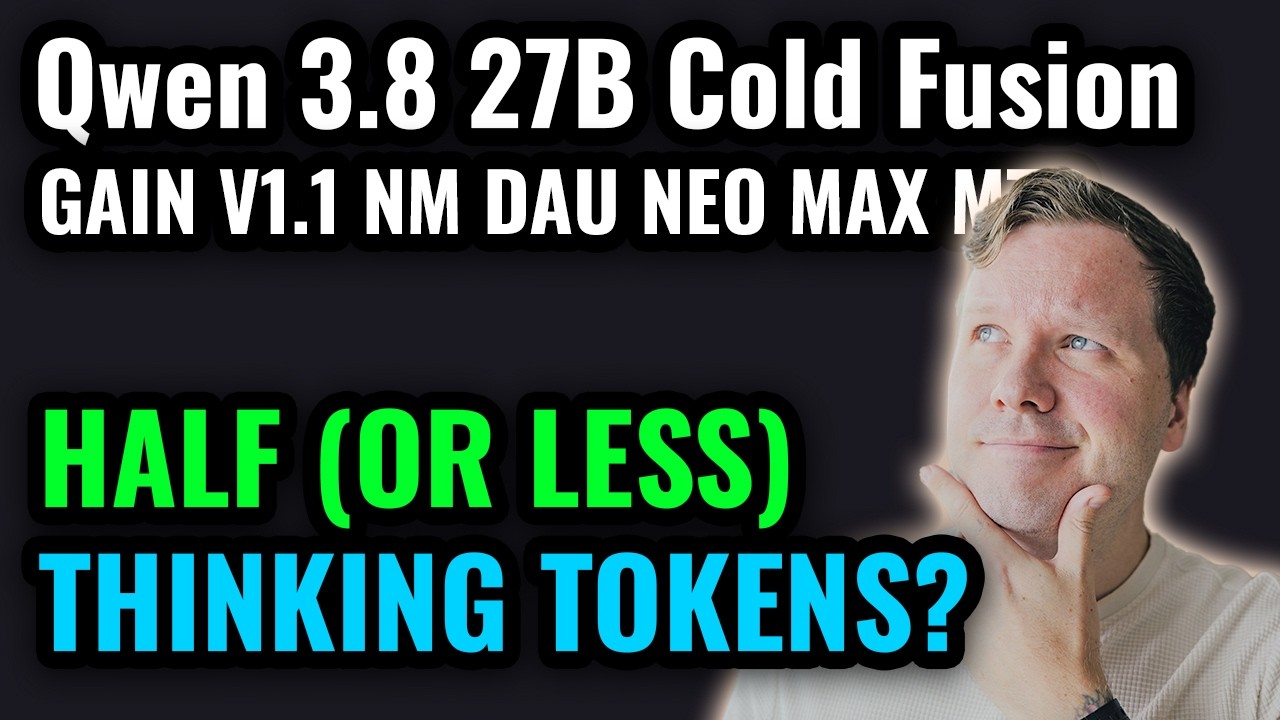
Evaluates Qwen3.8 27B Cold Fusion GAIN V1.1 NM DAU NEO MAX MTP against the base model using Performance, Memory, Agency, OpenAI Human Eval, Kanban, Sand Physics, Dungeon Crawler, Blender, and Godot.
25:06
Evaluates GLM 5.3, Qwen 3.8 Max and Grok 4.6 using ten hard briefs in Blender, Unity and Godot to assess reliability and capability in building real 3D projects.
Hands-on guide demonstrating local fine-tuning of the Qwen3.8 27B model using custom datasets.
Evaluates Qwen 3.8-27B MTP depths 2, 3, 4 versus off using llama.cpp on GMKtec EVO-X2, measuring throughput and verifying output identity via hashes under greedy and sampled settings.
Compares Qwen 3.8, 3.6 and 3.5 using 397 generations on an RTX 5090, analyzing MTP layer activation, split vision encoder, post-training effects, Terminal-Bench scores and token speeds.
Locally installs and tests Granite 4.2 generation in 3B and 8B variants using ibm-granite/granite-4.2-3b resources.
Demonstrates cleaning reference audio with UltimateVocalRemover and integrating OmniVoice into the TalkWithMe app for offline, real-time conversations with AI personas using cloned voices.
Tests Qwen 3.8 27B, Muse Glimmer 30B and Gemma 4 26B on an RTX 5090 using Ollama, evaluating consistency across 12 accounting questions run 10 times each.
Locally installs and tests FreeToken, an edge-native Mixture-of-Experts (MoE) serving engine.
Evaluates ClinePass for accessing open-weight coding models within Cline, testing performance on a real-world project using Plan and Act modes alongside the World of AI Benchmark tool.
Locally installs and tests EVIE-Preview-4.5B, a visual document retriever featuring native 128-dimensional token vectors.
Evaluates whether the Ornith 1.5 35B A3B mixture of experts model surpasses the original 1.0 version through a coding challenge comparison.
Performs unsloth/Qwen3.8-27B-GGUF quantizations Q1-Q8 using HumanEval within Kanban, Blender and Godot environments.
5:15
Runs Qwen 3.8 27B on an RTX 4060 using unsloth IQ4_XS quant and Pi agent harness, comparing results against Claude Opus 4.6 in agentic coding tests.
Tests DeepSeek V4 Flash Vision using DeepSeek Harness on browser workflows, 3D wrestling games, Blender scenes, Godot, C++ skate games, cinematic games, and frontend design.
WorldClaw generates editable 3D worlds from prompts using image generation, segmentation, and Hunyuan 2D-to-3D tech to create separate 3D assets like trees and buildings.
Evaluates Ling-3.0-flash using Inferencer App v2.3.4 on M3 Ultra 512 GiB, noting its Kimi K3 attention architecture and origin from Qwen's sibling company.
Evaluates 45 llama.cpp configurations for Qwen 3.8 27B on an RTX 5090, analyzing speculative decoding, KV cache quantization, flash attention, and context window impacts on speed and VRAM usage.
SIE enables self-hosted embeddings, reranking, extraction, and text generation on custom hardware via a single open-source server.
Evaluates DeepSeek Harness against Claude Code and OpenAI Codex via benchmarks, covering installation, plugin architecture, Web UI, agent trajectories, and pairing with DeepSeek V4 Pro.
Demonstrates Qwen3.6-35B-A3B inference on RTX 3060 using llama.cpp MoE expert caching combined with speculative decoding, achieving 70-80 tok/s via --moe-cache-profile flags.
19:16
Tests Qwen3.8-27B via NINFER on RTX 5090 with DeepSeek harness across ~300 iterations to build a 3D Acropolis scene in a single HTML/CSS/JS file.
Locally installs and tests S1-Mini, a 0.6B-parameter text normalizer for speech-to-text output.
Ranks frontier models based on real use across front-end design, one-shot capabilities, cost, speed, and subscriptions, placing Fable 5 at the top.
Compares Ornith-1.5 35B-A3B MoE and Qwen3.8-27B dense models via SVG creation, website generation, Playwright MCP tool calls, and .NET code migration tests.
Demonstrates full local installation and execution of MiniMax H3 within ComfyUI using the MiniMax-H3-Turbo-Lora adapter.
Evaluates Qwen 35B A3B against Ornith 1.5 using llama-server, pi harness, Bob-Bench, and fuzzing across decode speed, wall-clock time, and pareto efficiency graphs.
Tests Traycer’s shared workspace enabling Claude Code and Codex collaboration via agent-to-agent communication while building the MarketPulse dashboard.
Covers Deepseek Vision, Ornith 1.5, SenseNova U1.5, Bernini v2, Audio8 TTS 0.1B, Evoke, 4DAnyone, GeoWeaver, Qwen Video Edit, Happy Shrimp, Comfy MCP, Gen 1.5 and Avo.
Tests Ox Alpha, a reasoning model designed for coding, sustained agentic work, and production workloads.
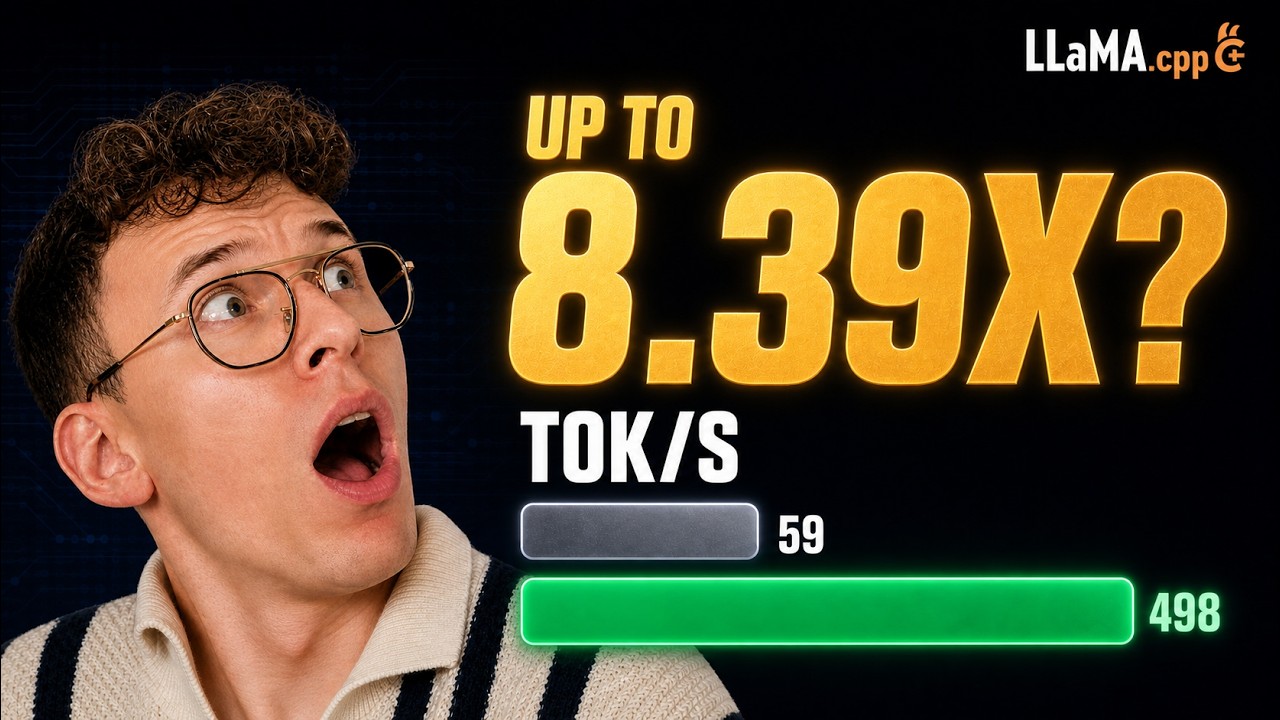
Benchmarks DFlash 2, n-gram, MTP and combinations for Qwen 3.8 27B in llama.cpp on RTX PRO 6000 Blackwell using LiveCodeBench and an 18-turn coding session.
Side-by-side coding test using Claude Code on Ollama to generate Space Invaders, Breakout, and Tetris HTML canvas games with Qwen 3.8 27B, Muse Glimmer, and Gemma 4 on an RTX 5090.
Demonstrates configuring an 8-bit quantized Qwen3.8-27B with DeepSeek Harness to edit its own code and enable inline image and video support via plugins.
Outlines a three-week curriculum covering free AI APIs, prompts, chains, memory, agents, and RAG, alongside setting up the repository with UV and selecting the virtual environment.
Tests Ornith 1.5 35B Q4 and Q8 quantized versions across browser OS, Subway FPS, C++ Skate Game, 3D CAD Model, Watch website, and Street Yeet game tasks.
Locally installs and tests empero-ai/Qwen3.8-4B-Distill-GGUF using GGUF format.
Demonstrates building a local financial RAG using Qwen 3.8 27B, Ollama, Qdrant, LangChain and Chainlit on SEC 10-K filings with hybrid search, agentic filtering and streaming.
Locally installing Qwen3.8-27B Obliterated demonstrates risks associated with deploying this uncensored model in production environments.
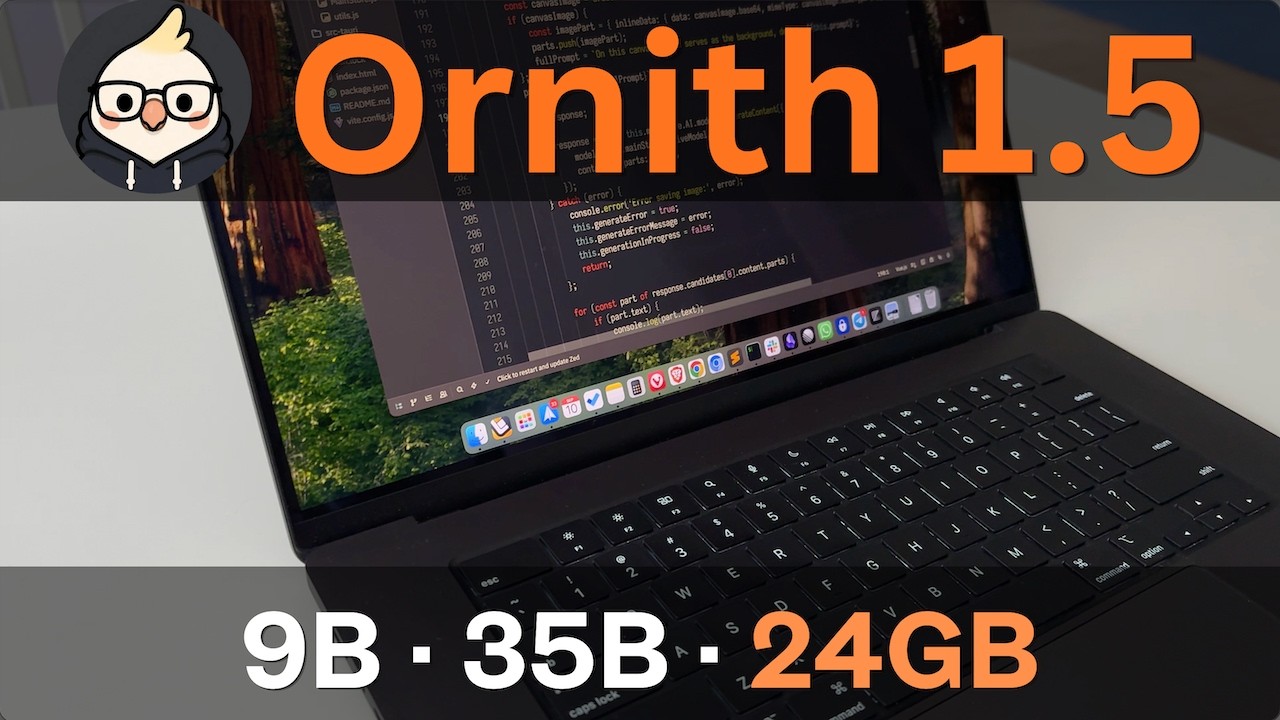
Speed benchmarks for Ornith 1.5 9B dense and 35B MoE models running on a MacBook M4 Pro with 24 GB unified memory.
Covers Tripo P2.0, mRNA cancer vaccine trial results, Qwen3.8 open weights, OpenAI cyber pacing pause, ChatGPT features, Meta AI app, Perplexity Brain, Gemini updates, Claude integrations, HappyShrimp